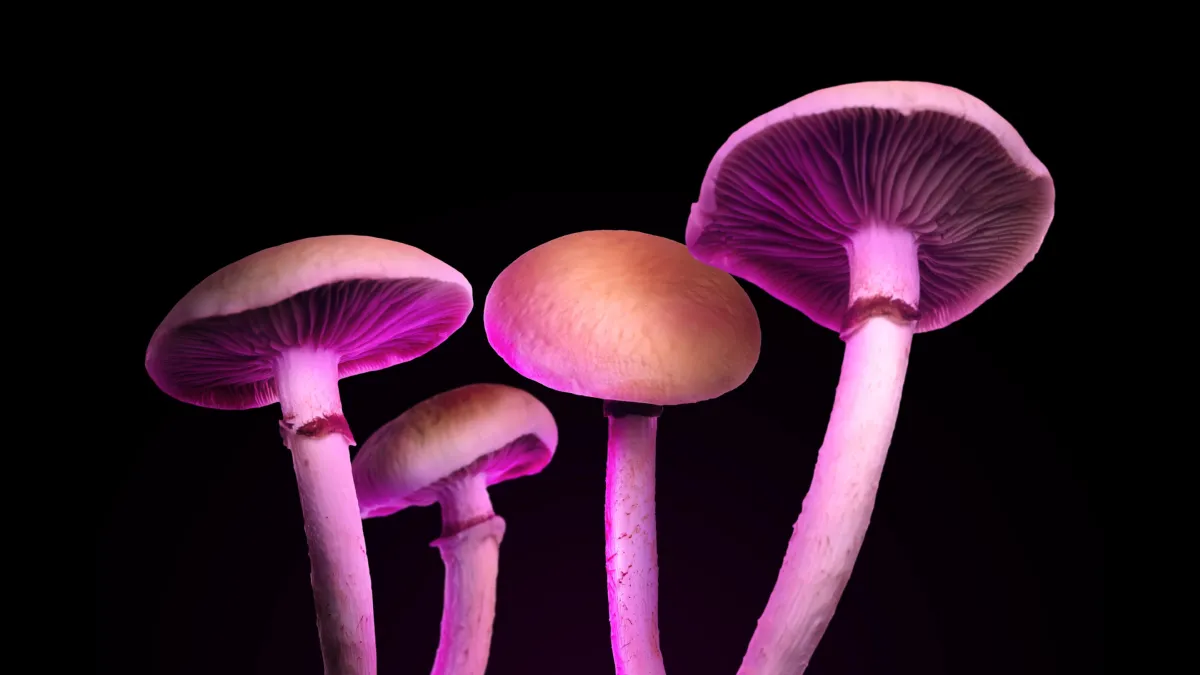
A story has been moving through wellness and psychedelic circles on Instagram and beyond: an 80-year-old woman with advanced Alzheimer's disease, who had barely spoken for five years, began talking again after a single high dose of psilocybin mushrooms. She told stories. She made jokes. Caregivers who had given up on hearing her voice were suddenly having conversations with her.
It sounds almost too good to be true, and it's worth being honest from the start: it is one person, one case, and one very unusual result. But the underlying report is real, it was published in a respected scientific journal, and it points to something genuinely interesting happening in the brain. Here is what we actually know, what the science says about why it might have happened, and where the wider research currently stands.
What happened, according to the case report
The case was published in Frontiers in Neuroscience in May 2026 by researchers Marcos Lago, M. Cerveira, and J.X. Simonet, working with the Associação Cruz de Ankh in São Paulo, Brazil. The patient was a Japanese-American woman in her 80s with a ten-year history of Alzheimer's disease. For the previous five years she had been largely non-verbal, speaking only in single words, incontinent, dependent for dressing and mobility, and emotionally flat — the kind of decline families usually associate with the final, most difficult stage of dementia.
She received five grams of psilocybin-containing mushrooms (an "Enigma" strain) under supervision. The acute phase involved heavy sweating and a long, sleep-like state. About nineteen hours later, she woke up and began speaking spontaneously for hours, recalling autobiographical memories, recognising family, and engaging socially in a way she hadn't for years. Over the following weeks, caregivers also reported improved mobility, regained bladder control, and a return of facial expression and humour. A second, smaller dose a month later produced a similar, milder effect.
The researchers themselves were careful with their language, describing it as a "transient multidomain functional improvement" rather than any kind of reversal or cure. The gains faded over time. There was no control group, no second patient, and no way to know how often this would happen in someone else. It's one data point — but it's a data point serious neuroscientists are now paying attention to.
Why would a psychedelic mushroom do this at all?
To understand why this case is scientifically interesting rather than just strange, it helps to know roughly what psilocybin does in the brain. Once ingested, psilocybin converts to psilocin, which binds strongly to the 5-HT2A serotonin receptor — a receptor that's especially dense in the cortex, the outer layer of the brain responsible for higher-order thinking, memory, and self-awareness.
Activating that receptor does two things relevant here. First, it temporarily disrupts the default mode network, a set of brain regions that normally run in a fairly fixed, habitual pattern and that becomes especially rigid in conditions like depression and, in a different way, in advanced dementia. Researchers studying this effect describe the brain becoming briefly more "entropic" — less locked into old grooves, more able to access connections that are normally suppressed. Neuroscientists have floated the idea that some abilities lost in severe dementia aren't necessarily destroyed, but buried under networks that have become too rigid to express them. A temporary loosening of that rigidity may be what let this woman's speech and memory surface again, even briefly.
Second, psilocybin appears to promote neuroplasticity at the cellular level. Lab studies have shown it increases the growth of dendritic spines — the tiny connection points between neurons — and boosts brain-derived neurotrophic factor, or BDNF, a protein that helps neurons survive, grow, and form new connections, and one that tends to decline in neurodegenerative disease. None of this rebuilds a brain damaged by a decade of Alzheimer's. But it may explain why a single dose could produce a temporary window of improved function rather than just a hallucinatory experience.
It isn't an isolated idea
This case landed at a moment when research into psilocybin and the aging brain was already building. A 2025 study in mice bred to develop Alzheimer's-like pathology found that repeated low-dose psilocybin reduced chronic neuroinflammation and improved neuron growth in the hippocampus, a brain region central to memory. Human research is starting to catch up: Johns Hopkins University currently has an open-label pilot study underway looking at psilocybin for depression in people with mild cognitive impairment or early Alzheimer's, and a separate trial is using PET imaging to measure how psilocybin affects synaptic density and cognition in people with mild cognitive impairment, expected to complete in 2026.
This builds on a much larger and better-established body of work on psilocybin and mood. Trials at Johns Hopkins and Imperial College London have repeatedly shown rapid, substantial, and often sustained reductions in depression after one or two supervised psilocybin sessions, including in a large COMPASS Pathways trial for treatment-resistant depression and a head-to-head comparison with the antidepressant escitalopram. The evidence has been strong enough that the FDA has granted psilocybin "Breakthrough Therapy" status for depression — a signal that the broader scientific and regulatory world takes this compound seriously, well beyond one viral case.
What this does and doesn't mean
It would be irresponsible to read this case report as "psilocybin cures Alzheimer's." It doesn't, and the researchers who wrote it up are the first to say so. This was a single, closely supervised clinical observation, not a treatment protocol, and psilocybin carries real physiological risks for older adults, including effects on heart rate, blood pressure, and the disorientation that can come with the experience itself. This is not a basis for anyone to self-administer mushrooms to an elderly relative with dementia, and any future treatment for Alzheimer's would need to come through properly controlled trials and medical supervision.
What it does suggest is something quietly profound: that some of what severe dementia takes away might be suppressed rather than gone, and that the brain may retain more latent flexibility, even late in life and late in disease, than we've assumed. That idea — that consciousness and connection can resurface under the right conditions — is part of why interest in psilocybin has moved so far beyond the lab.
Psilocybin retreats and where Spain fits in
That broader curiosity is exactly what's driving the growth of psilocybin retreats across Europe, with Spain becoming one of the more established settings for this work thanks to its climate, its more permissive legal grey area around personal use, and a growing number of centres built specifically to hold these experiences safely.
Among the psychedelic retreats in Spain, La Mezquita, based in El Campello on the coast north of Alicante, focuses on this kind of intentional, supported psilocybin and plant medicine work — not as a medical treatment, but as a structured, screened, and held space for people seeking insight, clarity, or personal change. If research like this case report does one thing for the public conversation, it's a reminder that these substances deserve to be approached with the same seriousness as the science studying them: with preparation, with proper screening, and with people around you who know what they're doing.
Sources
Lago M, Cerveira M, Simonet JX (2026). Transient multidomain functional improvement in advanced Alzheimer's disease following high-dose psilocybin-containing mushroom administration: a case report. Frontiers in Neuroscience, 20:1813281. frontiersin.org
Madhu LN, et al. (2025). Psilocybin maintains better brain function in an Alzheimer's disease model with reduced neuroinflammation and improved hippocampal neurogenesis. Alzheimer's & Dementia. pmc.ncbi.nlm.nih.gov
Erritzoe D, et al. (2024). Effect of psilocybin versus escitalopram on depression symptom severity. eClinicalMedicine. thelancet.com
Davis AK, et al. (2020). Effects of psilocybin-assisted therapy on major depressive disorder. JAMA Psychiatry. pubmed.ncbi.nlm.nih.gov
Default mode network modulation by psychedelics: a systematic review. International Journal of Neuropsychopharmacology. academic.oup.com
Clinical trial NCT06041152 (psilocybin and synaptic density in mild cognitive impairment). clinicaltrials.gov